|
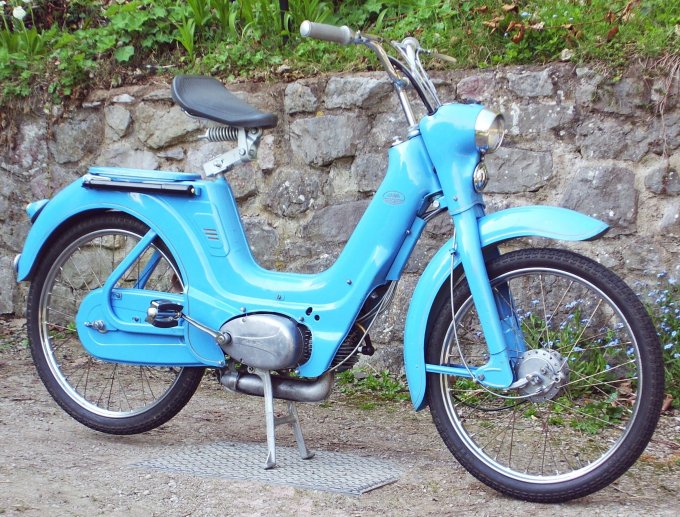
The Jawetta Moped
The Jawetta was introduced in 1958 although it was just referred to as the Jawa Moped at first, the Jawetta name appearing slightly later in literature and adverts. This, like the more well known Pionyr ultra lightweight motorcycle before it, was designed by the Jawa factory in Týnec near Prague. But unlike the Pionyr, the Jawetta was also manufactured in the main Jawa factory in Týnec. The Pionyr was manufactured, from the first “Pařez“ (Stump) model in 1955, by a company called Považské Strojárne in the northern Slovak town of Považská Bystrica.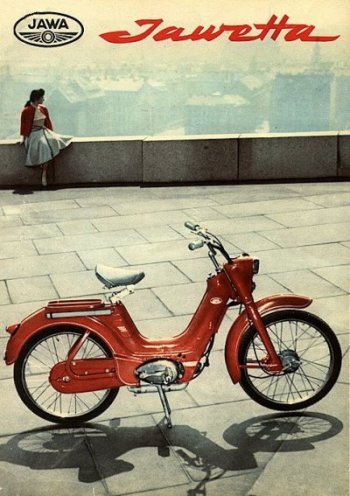
This makes the Jawetta the only true Jawa moped since all subsequent mopeds that were sold as Jawas, such as the Babettas, the model 05 & 20 scooters and the Mustangs were all also made in the Považské Strojárne factory alongside the Jawa 90s and Manet scooters. At 49.8cc it was the smallest capacity bike that Jawa ever produced.
The Jawetta was only produced for 4 years ceasing production in 1962. In that time it was sold across eastern Europe and to several western European countries, and the USA but not in Britain. I have literature from Finland and from Holland showing that they were sold there as well as from the USA where this leaflet comes from. In 1961 a standard model Jawetta in the USA would have cost you $175, that is £62.50 at that time. By comparison, at about the same time a CZ175 would have cost you about £140.
The Jawetta was sold alongside the Pionyr with the Jawetta being advertised as “more suitable for women and juveniles” with the Jawetta being a bit cheaper than the Pionyr. The main competition, in eastern Europe at least, would have been from another Czech moped manufacturer, Stadion, with its S11 moped, another model which never made it to Britain. The original Stadion was a more conventional “bicycle with an engine” type of moped and used a very similar engine that was made for them by Jawa. Many of the engine parts are common to both the Jawetta and Stadion as well as some other components. Various Stadion models sold until 1966, and later models used a variation on the Jawetta’s monocoque type frame construction as well as using forks and headlamp nacelle identical to the Jawetta’s.
The Jawetta has a number of interesting and unusual features. Probably most notable is that there is no frame as-such but the moped is of monocoque construction with the main structural part being formed from two symmetrical pressings of 0.8mm (0.032”) sheet steel welded together longitudinally in a central rib running the length of the moped and extending to form the rear mudguard. This forms partly semi-closed and partly fully closed
|
Technical Data
|
|
|
Engine
|
two stroke, air cooled,
single cylinder
|
|
Capacity
|
49.8 cc
|
|
Bore
|
38 mm
|
|
Stroke
|
44 mm
|
|
Compression Ratio
|
1:7.5
|
|
Power
|
1.5 hp at 4,750 rpm
|
|
Engine Lubrication
|
mix oil in petrol - 1:25
(1:16 for running in)
|
|
Fuel consumption at 30 km/hr
|
1.65 lt / 100 km (170mpg)
|
|
Fuel tank capacity
|
3 litres
|
|
Machine weight
|
dry - 42 kg
|
|
Maximum load
|
220 lbs (100 kgs)
|
|
Maximum speed on level ground
|
28 mph (45 km/hr)
|
|
Primary drive
|
helical tooth gear
|
|
Secondary drive
|
chain 12.7 x 4.8 100 links
|
|
Overall gear ratio
|
1st gear - 1:27.90
|
|
|
2nd gear - 1:13.88
|
|
Suspension, front
|
leading link, 62 mm travel
|
|
Suspension, rear
|
swing arm, pivoted in engine block,
coil spring in frame, 58 mm travel
|
|
Wheels - 23” x 2”
|
Tyres - 23” x 2.00”
|
|
hollow sections reinforced with several stays.
Although this makes a very rigid but light structure for the frame, the down side is that it makes working on the moped very difficult. Normal service items, plug, points, magneto clutch etc. are fairly accessible but you need very thin hands and long fingers to be able to unscrew the down-draught carburettor top or reach the throttle cable adjuster for instance. The slow running screw and the main jet are accessible with a screwdriver through a small hole in the right hand side of the bodywork and the carb tickler is accessed by a finger through a similar hole in the other side of the frame.
The air cleaner sits inside an enclosed section above the engine and requires the carb to be removed first to be able to remove it. The 3 litre fuel tank sits inside the front section of the frame and slides up from the bottom towards the steering head. It is not possible to remove the tank without removing the engine first. Removing the engine is a difficult job in itself, since the rear suspension and the centre stand are both fixed to the engine and have to be removed and replaced with it.
The rear wheel is not hard mounted as it might appear but there is a pivoting fork supported in bushes in an extension on the rear of the engine. The bushes are lubricated automatically by the gearbox oil. The upper end of the rear fork fastens to a single large spring located inside the frame under the seat.
The front suspension is by a pair of pivoted bottom links with springs located inside the bottom section of the “U” shaped pressed steel fork legs. Both front & rear springs have rubber inserts acting as progressive bump stops.
The moped has two gears, cable operated by a left hand twist grip using components identical to those used for the throttle on the 250 & 350 Jawas of the period. The centre position is neutral with first being engaged by twisting the grip away from the rider and second towards the rider. The clutch lever, that turns with the twist grip, has a tongue that engages into three slots machined in the handlebar, holding the gear engaged against spring pressure from the cable. First gear is barely needed when starting on the flat but gives the moped good hill climbing ability.
My Jawetta
I bought my moped from Slovakia early in 2011 and it is probably the only Jawetta in the UK as they were never imported here. It was made in 1960 and had done only 905 kilometres in its 51 years - so not even run-in yet!
I was contacted by e-mail, through the web site by a Slovakian lady named Andrea living in Ireland. She sent a few pictures and asked if I knew of anybody who might be interested in buying it. It seems that an uncle of hers bought the Jawetta from new and only used it a couple of times before hanging it up in his workshop for the next 40 years. On the gentleman’s death it passed to, Andrea’s father, Vojtech, who also ran it a bit and then put it into storage.
I had a brief discussion about the moped with my wife, but decided to go ahead and buy it anyway. A price was agreed and money transferred. The moped was in the town of Okres Piešťany about an hours drive from Bratislava in the Slovak Republic.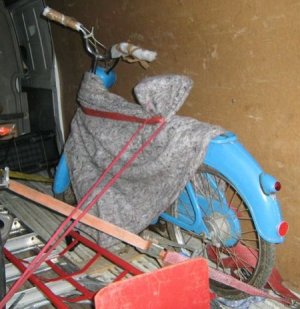
After a failed attempt to get a UK bike transport “specialist” to collect the moped, Andrea found a local, small delivery company who were capable of doing the job. The company, VAN-2-3, make regular trips between the Czech and Slovak Republics and the UK in a van delivering and collecting bikes and mopeds. Dominik Kasubjak who I dealt with, speaks perfect English and was very helpful and efficient. There was a couple of weeks wait until his next scheduled trip over here when he collected the moped from the seller and transported it all the way to my doorstep in North Wales and all for a very reasonable charge – cash on delivery. I would thoroughly recommend VAN-2-3.
Contact VAN-2-3 at http://www.van23.com/
e-mail van23@van23.com phone +421 907 260 321.
The moped is completely original except for the seat having been replaced by a later Babetta one as the original one was eaten by mice while the moped was in storage. It is still fitted with the original spark plug from 1960 and the original tyres – I expect that even the air in the tyres is original. Vojtech was kind enough to send me a leather “flying helmet” which was bought by the original owner at the same time as the moped - suitable protective headgear in 1960. The moped has no registration as this was not required for mopeds in 1960 Czechoslovakia.
The moped seems to have been looked after quite well, there is no real damage evident just a few scratches in the paint – notably on the front mudguard and there seems to have been some sort of a problem with the wiring, with evidence of a short circuit at some time. One or two small rubber parts had deteriorated – rubber buttons for the steering lock stops and the seal in the fuel filler cap. The only rust evident is on the spokes and one patch of 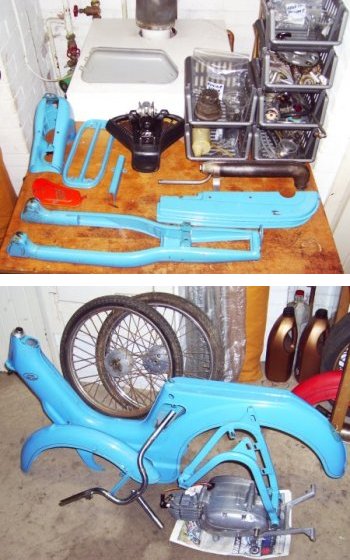 missing chrome on the front rim. This cleaned up all right after a scrub with a wet Brillo pad – a tip for cleaning up pitted chrome. missing chrome on the front rim. This cleaned up all right after a scrub with a wet Brillo pad – a tip for cleaning up pitted chrome.
I have stripped it down in order to give it a thorough clean and remove all the dust and a little bit of road muck/grease around the engine and to be able to more easily service everything. I T-Cut all the paintwork, degreased the outside of the engine and went over all the plated steel parts with a small, fine wire brush. All the cables - and there are 7 of them - were lubricated inside and cleaned outside with WD40. The best thing I have found to clean rubber and plastic parts is Swarfega and a tooth brush then wash in soapy water. It has been reassembled exactly as original. All the original nuts, bolts and washers have gone back where they came from. One missing screw was replaced with a correct type from one of my coffee jars of fixings removed from other Jawa-CZs – NEVER throw anything away!
I managed to find a new replacement seat to exactly the original design, luckily the seat is the same one as used on the less rare Stadion S11. That came from Slovakia along with the one or two other small parts that had to be replaced. The wiring damage was repaired retaining the original wire and terminals and all the original wiring and sleeving reused
I cleaned & set the points and the plug, replaced the gearbox oil and then fired her up – second kick! She runs beautifully, as you would expect from a 905km from new, bike. My first chance to ride it was round the car park at the Stafford Classic Bike Show in April 2011. I expected it to be a little awkward to ride with the hand gear change and a rear brake that is applied by pedalling backwards but it is no problem. Starting on flat tarmac from stationary barely requires first gear and I expect would be quite possible in second once I’m used to the short travel clutch lever. In first gear she carried me surprisingly easily up the rather steep vehicle ramp to the upper level of the show hall.
The moped was at Stafford to be exhibited in the show on the Jawa CZ Owners Club stand, where it won the award for Most Original Machine. I’ve now got a dating letter from the Owners Club and once insured and MoTd I’ll apply for registration although I am unlikely to use it much on the road.
John Woods
adapted from an article from Torque
the magazine of the Jawa CZ Owners Club – May 2011.
|